
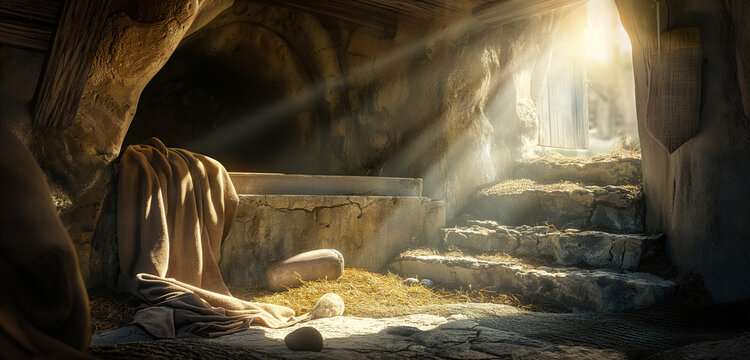
The Resurrection: Love’s Final Victory
If the Christian story ended with the birth of Christ, there would be no point in it.
If it ended with one of Jesus’ great miracles—say, the multiplication of the loaves to feed the five thousand—there would be no point in it.
If it ended with the institution of the Eucharist, there would be no point in it.
Even if the Christian story ended with the crucifixion, there would still be no point in it.
The point of our faith—our belief in a Creator who is Love, who did not give up on us even when we turned away—the point of our existence, is the Resurrection. If Jesus did not rise from the dead, none of the rest would matter: not His birth, not His miracles, not the gift of His Body and Blood, not even His brutal death.
His Resurrection is the proof that He is God: the Lord of life, the Alpha and the Omega. But why all this drama? Could not God have revealed this truth in some other way—one less bloody and brutal?
The War for the Heart of Creation
When God created the world, He created it good. Everything was good. And the crown of His creation—humanity—He created very good: made in His image and likeness, with immortal souls and eternal destinies. We were made for one purpose: to share in His goodness.
But Satan, jealous of both God and His creation, desired to be like God. And so the great battle began in heaven, where Michael and his hosts cast Lucifer down, crying out: “Who is like God?”
Yet the battle did not end there.
Refusing defeat, the enemy turned his attention to the earth. Here, he waged war against humanity. Our first parents fell, and with them, every generation after. Even now, we fall—again and again—succumbing to temptation, grasping at what is not ours, claiming independence from the very One who sustains us.
Like him, we say: we do not need God.
With the catastrophe of Eden, the human race was set on a path toward destruction—wounded, disordered, and, in a sense, sick unto death. We allowed ourselves to be deceived. We rebelled. We became captive—enslaved by sin, estranged from God, unable to see clearly, unable to love rightly. Cut off from His life, separated from His presence, we became, as Scripture says, dead in our sins.
But God is not one to abandon His work.
How could He leave His own creation to perish? In His goodness, He willed to defeat the enemy, to rescue humanity, and to restore a fallen world.
Yet this was no simple matter. Humanity was not only bound by the enemy, but also burdened by guilt—guilty of its own rebellion.
How could God give fallen humanity a chance to turn away from darkness so that they might be truly forgiven, and not merely excused? And invasion in force might compel obedience , but it would not inspire love. It might produce fear, but not freedom.
How could God call forth genuine faith while preserving our freedom?
The answer is the most astonishing event in all of history.
He would not invade in force. He would invade in secret.
The Hidden Invasion of the King
God chose to take upon Himself the destiny of the human race by becoming one of us—doing what we could not do, restoring what we had lost. He would take on human nature, corrupt and wounded, and join it to himself then offer it up in sacrifice. And evil is powerless before such sacrifice.
By this astonishing act of humble condescension, God forever changed the fortunes of the human race. He took a dying race of zombies and raised it to be higher than angels, making them sharers in the divine life. “God became man so that man might become God”
When Jesus came among us, he wasn’t just paying a visit, he was entering enemy territory. He slipped unawares into a doomed land. Quietly, almost unnoticed, He stepped into a broken world. In the hiddenness of the Virgin’s womb, in the poverty of a stable, He came among us incognito. Few understood what had happened. He was thought to be only the son of Joseph.
So at his baptism when the heavens opened and the Father declared, “This is my beloved Son,” it was baffling, most of all to the enemy.
The enemy subjected him to testing in the wilderness, but Jesus just answered with scripture and sent him packing. Then Jesus began to move about, humiliating and casting out the enemy’s minions, forgiving sins, and even raising the dead. Whoever He was, He had to be dealt with.
And so the enemy made a fatal miscalculation—the very one God had foreseen.
He moved to destroy Jesus.
He had Jesus killed, thinking that, as a son of Adam, He too would fall under the power of death—and the sooner and more brutally, the better. Then all would remain under the dominion of the devil.
But in this, he was deceived.
When the good thief breathed his last, the enemy rushed to claim what he thought was another conquered soul, ready to assert his dominion. But his triumph quickly turned to terror. For this soul did not come alone. The King had gone before him—entering that dark domain not as a victim, but robed in blinding light, with power and authority, advancing upon the prince of darkness.
Too late, the truth was revealed.
He saw who Jesus truly was, but by then it was too late. The trap had sprung upon itself. The deceiver had been deceived. Had he known, he would never have crucified the Lord of glory. It never entered the darkest corners of his proud mind that God would unite himself so humbly with humanity.
Easter: The Dawn of the Final Victory
And so we arrive at Easter.
This is the victory of love over evil. The victory of life over death. The victory of God, who loves us too much to leave us behind.
Is there any love story that holds a candle to this?
God has determined that it is not fitting that you should be lost. What a gift you hold: a soul so precious that, though the enemy pursues it tirelessly, the true King has fought for it and laid down his own life for it.
If you are attending the Easter Vigil Mass tonight, pay close attention to the liturgy. It is what St Augustine called the “Mother of all Holy Vigils”. And indeed it is. How rich is the beauty of this night. How full of meaning and mystery.
From darkness we are led into light. The Exsultet rings out, calling Mother Church to rejoice with the hosts of heaven, for her King has risen victorious.
The Liturgy of the Word unfolds the entire Salvation History. We renew our baptismal promises and welcome new brothers and sisters into our family of faith. And at last, we come to the Eucharist—the source and summit of it all.
And still, this is only the beginning.
The Church celebrates not just a day, but an entire octave of Easter as one great solemnity. And beyond that, fifty days of rejoicing. The victory is too great to be contained in a single moment.
Yet even now, though the war has been won, the battle continues.
But do not despair. There remains in this world a resistance against the enemy: the one holy, Catholic and Apostolic Church. And we are part of it. Not with weapons of force, but with lives of repentance, faith, and love. Each act of turning back to God is a step toward the final victory. Constant, joyful repentance is how we fight for God.
So we do not lose sight of the work before us.
For one day, the struggle will end. And we will be gathered at last into the fullness of glory, in the homeland for which we were made. (KA)