
Staying at the Table
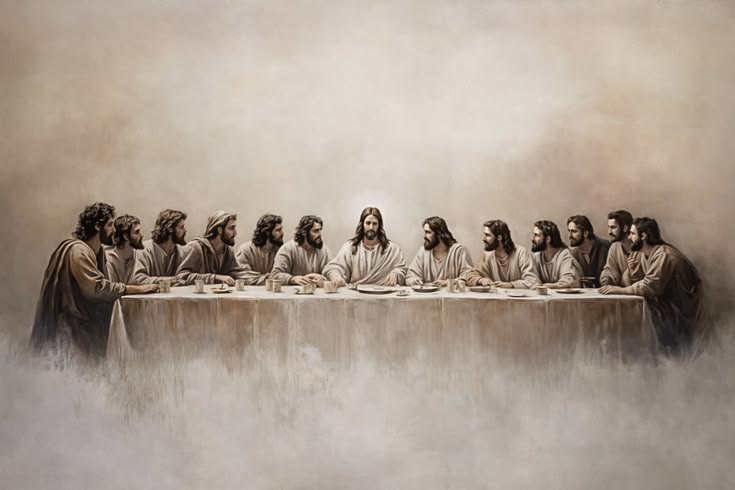
As we continue through Holy Week, today’s Gospel brings us into a quiet and heavy moment at the table with Jesus and His disciples. Everything feels close and intimate, almost still. Then Jesus speaks. He is troubled, and He says that one of them will betray Him.
The room shifts. The disciples look at one another, unsure. No one immediately knows who He is speaking about. It is not obvious or dramatic. It is quiet, almost hidden. And perhaps that is what makes it so personal.
Because while betrayal may feel far from us, the smaller movements of the heart are not. The moments when we drift, when we grow distracted, when we begin to pull away without realising it. When we are still present outwardly, but not fully within.
Judas was at the table. He shared the same space, the same meal, the same closeness. And yet, something within him had already begun to turn. Eventually, he leaves. It is a simple line in the Gospel, but a heavy one. He leaves the table.
There is a quiet question here for us. Not whether we would betray, but where we may be tempted to step away. Not physically, but within. Where do we begin to withdraw, to close off, to disengage?
Peter, on the other hand, remains. He is sincere. He loves Jesus. When he says, “I will lay down my life for you,” he means it. And yet, Jesus knows what Peter does not yet see. That his strength will falter. That his love, though real, is not yet steady.
This is where the Gospel meets us. Many of us are not trying to walk away. We are trying to stay. We want to be faithful. And yet we know we are not always as present as we hope to be.
We see this even in the most familiar places. We come for Mass, we sit, we respond, we follow along. But our minds wander. We notice the lector, the choir, the way things are done. We think about what is next, what we have to do later, even something as simple as what we will eat after. We are there, but not fully there.
In the same way, this lack of presence shows itself in small, everyday moments. At home, we lose patience more quickly than we expect. A simple exchange turns tense. A repeated question feels heavier than it should.
It can be in how we respond when someone shares something we do not fully agree with. Instead of listening, we begin forming our response. Not out of openness, but out of the need to correct or clarify.
It can be in group settings, where we feel the need to contribute something insightful, something that adds value, something that shows we are paying attention. And yet, beneath it, there may be a subtle desire to be seen.
None of this comes from a lack of sincerity. It comes from a heart that is still learning how to love without pressure, without needing to be right, without drifting away.
Holy Week does not ask us to hide this. It invites us to remain. To remain at the table, like Peter, even when we see our own weakness. To remain, even when we realise how easily we become distracted or divided. To remain, not because we are ready, but because we are willing.
Jesus does not turn Peter away. He does not push Judas out before he leaves. He remains present, even in the tension. There is something deeply consoling in that. We are not asked to prove ourselves before we are allowed to stay. We are simply invited to remain.
Perhaps today, remaining is not complicated. It may be as simple as making space to be with Him. To sit quietly before the Blessed Sacrament, even for a few minutes. Not to say much, not to resolve everything, but simply to be there.
As we continue this Holy Week journey, we are reminded that Jesus remains with us. Not because we are steady, but because He is. And in staying with Him, slowly and quietly, we begin to learn how to remain. Not perfectly, but more honestly. (BV)
(We will have a Holy Hour before the Blessed Sacrament this Wednesday, 1 April at 8pm. It is a simple invitation. To come, to be still, and to remain with Him.)